Still Life takes place in a town being destroyed by the construction of a dam. The Three Gorges Dam project forced people to leave their homes, meaning personal homes had to be relocated not by the will of the people, but by government policy. People who lost their homes are forced to move out and relocate to different areas, portraying the experience of extrinsic migration. The only work they can get are labor jobs, such as deconstructing or destroying the buildings or working in the coal mines. Along the way, we get to see people demolishing buildings and destroying nature.
The film feels slow and empty, reflecting the loneliness and uncertainty people experience through rapid change. Homes are destroyed, people are displaced, and emotional connections seem weak or broken. Still Life uses long takes to create discomfort. It shows how humans overpower and destroy the environment to create instability, demonstrating change as a forced thing driven by development that ignores individual lives. Two characters' journeys reveal how modernization has damaged not only the physical environment but also human relationships.
(Haeun, Zane, Nawoo, Sinbi, Soojin, Jae Yong)
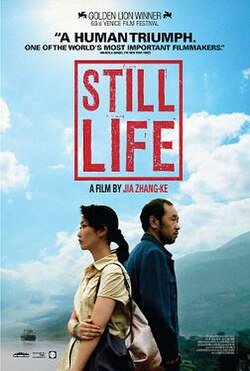
Theatrical poster
"Still Life portrays the experience of extrinsic migration."
— Zane Hang
"Still Life shows change as a forced thing driven by development that ignores individual lives."
— Nawoo Kim
"The Three Gorges Dam project did force people to leave their homes. It didn't follow the people's will."
— Jae Yong Park
A note on this essay: The collective response above was assembled from individual student journal entries written immediately after the screening. Entries were compiled and edited using AI to eliminate repetition, preserve disagreement, and honor each student's voice — reducing the total word count by 75%. The writing remains the students' own.