Munyurangabo as a film feels very natural and honest, moving at a slow pace that makes it seem more real. It doesn't show big dramatic scenes of violence, but instead focuses on everyday actions like walking, eating, talking, farming, and rebuilding the walls of their homes. This quiet and respectful depiction of everyday life in Rwanda after the genocide captures real emotions and small moments without exaggeration. The conflicts are tied to personal trauma and haunting memories, following a single character's struggle between revenge and forgiveness. The story portrays both Hutu and Tutsi not as good or bad, but shows that both sides suffer from the aftermath.
This simple, realistic approach connects directly to social realism and Italian neorealism, using local, non-professional actors, natural locations, and simple dialogue to critique the society. Making the non-actors improvise their scenes with real-life experiences gives the audience a strong feel of realism. Yet, the story also feels staged rather than a pure documentary style, utilizing stylized acting and poetic shots to capture the lingering pain. It operates as a non-linear narrative where different causes and motives are revealed at different times, leaving the viewer to move through the story like walking across places with only a small piece of a puzzle.
The perspective behind the camera shapes this view, functioning as an outsider coming into the insider perspective. The director effectively treats the subject of genocide by not forcing a message and keeping the external gaze minimal without any "white savior" vibes. Even so, Lee Isaac Chung is an outsider. Does the outsider view inherently make the film less emotional than a local director's version? Even with background research and time spent volunteering in the community, an outsider can never live or relive people's actual experiences. This distance means the audience cannot fully know the depth of the character's pain and persuasion, changing the cultural gaze of the story.
Even so, the performance of the poem "Liberation is a Journey" brings out a strong collective, insider storytelling that honors the Griot tradition. This poetic intervention may feel a little pushy for the narrative flow as it fastens quickly to the ending and forces a sudden influence on the character's attitude, but when the poet recites the deep and sincere lines, looking directly into the camera, it connects personal pain to a bigger history. It adds a necessary social critique, showing that the society still suffers from consequences like a lack of education, famine, and gender inequality, proving that liberation is a continuous journey to truly recover.
(Gahyun, Maya, Haeun, Jiyoung, Zane, Joohee, Nawoo, Sally, Sinbi, Yoo, Yuna, Jeonju, Michelle, Crist, Lilo)
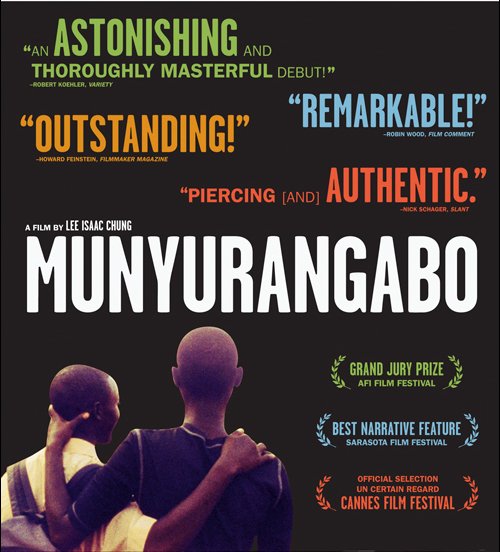
Theatrical poster
"The film feels very natural and honest, and the story feels respectful. Yet, Lee Isaac Chung is still an outsider and that outsider view might make the film less emotional than a local director's version."
— Gahyun Ahn
"Munyurangabo shows everyday life in Rwanda after the genocide without exaggeration. Instead of dramatic scenes, it focuses on real emotions and small moments. This matches the idea of social realism, which tries to show real social issues in an honest way."
— Nawoo Kim
A note on this essay: The collective response above was assembled from individual student journal entries written immediately after the screening. Entries were compiled and edited using AI to eliminate repetition, preserve disagreement, and honor each student's voice — reducing the total word count by 75%. The writing remains the students' own.