The Cave of the Yellow Dog uses a "fly-on-the-wall" type of filming to observe a nomadic Mongolian family, using a mix of wide shots that capture the beauty of the vast lands and effective close-ups that show the detail of a nomadic lifestyle. The film has great cinematography, but it is not done to impress the audience — it has a purpose; it is an intentional way to show the landscape and the realism of living as a Mongolian family, including multiple extreme long shots of the mountains and fields of Mongolia that make the family look small. The film centers a family of herders, showing their daily life in one place and ends with them packing up everything to leave and migrate somewhere else. The film portrays intrinsic migration as a cultural-survival custom and portrays the family living in harmony with nature. Even though nature can be dangerous and the beautiful scenery actually contains all the danger they face, it is also something people must respect and live with. The film felt warm and hopeful, showing change as something natural that people can adapt to while maintaining their traditions.
The film doesn't show destruction, but multiple scenes show the influence of modernization slowly appearing and intersecting with the family's life. This comes through conversations between the wife and husband, and visually, it is interesting to see how odd a plastic bucket looks inside a traditional ger — the bright green color of the plastic really contrasting with the red of the house interior. By having the natural environment and modernization intersect, the film does not hide the fact that there is a modern side to nomadic life in Mongolia.
Ultimately, The Cave of the Yellow Dog is both an authentic artifact and a romanticized projection of a Western ideal of Mongolia. On one hand, it is almost like a documentary, following a real family's nomadic lifestyle. On the other hand, it seems romanticized when it highlights the calm aesthetic and beauty of living on the go. Throughout the film, we see beautiful landscape and pristine weather, purposefully depicted to enhance the beauty. The scenery is the spectacle itself. One interesting aspect was how the film uses a lot of imbalanced compositions where characters are located almost at the edge of the screen. While it seems to capture an authentic artifact of the culture, the film does feel like an escape for a Western audience. It satisfies the free, primitive, and "oriental" vibe they might seek, reminding us of a romantic portrayal of the imaginary nomad concept. The article "Imaginary Nomads" notes that many Westerners view Mongolia as an "exotic and mysterious land," which can be seen in this film. This overshadows the issues and dangers of constant migration and the struggles of an entire family to survive.
(Maya, Jiyoung, Zane, Nawoo, Sally, Sinbi, Hojune, Jae Yong, Michelle, Crist, Lilo, Samuel)
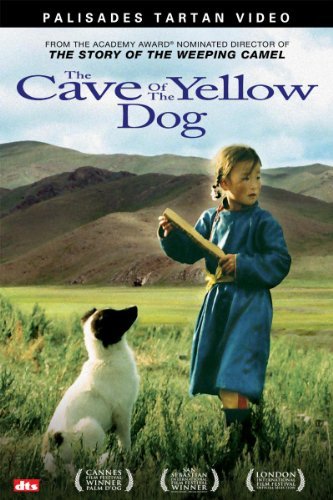
Theatrical poster
"Throughout the film, we see beautiful landscape and pristine weather. It seemed purposefully depicted this way to enhance the beauty."
— Zane Hang
"The Cave of the Yellow Dog portrays intrinsic migration as a cultural-survival custom. The film includes multiple extreme long shots of the mountains and fields of Mongolia that make the family look small."
— Hojune Lee
"The film satisfies the free, primitive, and oriental vibe Western viewers want and reminds us of a romantic portrayal of the imaginary nomad concept."
— Sinbi Kim
A note on this essay: The collective response above was assembled from individual student journal entries written immediately after the screening. Entries were compiled and edited using AI to eliminate repetition, preserve disagreement, and honor each student's voice — reducing the total word count by 75%. The writing remains the students' own.